American Kitsch: ugly Christmas sweaters
Tuesday, December 1, 2015
Believe it or not, if you do an internet search with the key words “ugly Christmas sweater” you will find pages of results, and you may wonder why so many people want an ugly Christmas sweater. Ironic as it is, this tacky item of clothing is a necessity for many holiday occasions and it’s an example of kitsch.
Kitsch is defined as art, objects, or design considered to be in bad taste because of excessive garishness or sentimentality, but sometimes appreciated in an ironic way. Ugly Christams sweaters possess all of those qualities.
There are ugly Christmas sweater contests, ugly Christmas sweater parties, ugly Christmas sweater theme days at work, and ugly sweater runs. December 18 is officially National Ugly Christmas Sweater Day!
In the past, this type of sweater was probably a nostalgic item or a funny gift you received and saved to wear once each year. Designed to be as unattractive as possible and often considered hideous, these awful sweaters have slowly changed from a fashion “don’t” to an ironically cool and trendy holiday necessity.
What is undeniable, the overly-festive, obnoxious Christmas sweater creates laughter and humor while it brings out memories of home and childhood.
The uglier, the better.
American kitsch: vintage motels
Wednesday, July 22, 2015
Kitsch is defined as art, objects, or design considered to be in bad taste because of excessive garishness or sentimentality, but sometimes appreciated in an ironic way. I love the nostalgia and humor of American kitsch and will occasionally share amusing examples of it in this blog. Today's post is dedicated to vintage roadside motels.
Are there vintage motels where you live?
Before corporations dominated the travel industry, there was a time when privately owned motels (first known as motor courts) were the norm. These family owned “mom and pop” lodgings began appearing during the 1930s when more people traveled by car instead of by train or horse. In 1900, there were 8,000 registered automobiles in America. By 1930, that number had dramatically increased to 23 million. People were driving all over the country and they needed places to sleep at night.
First there was roadside camping, then roadside cabins. As competition for tourist dollars increased, the offerings became more sophisticated and comfortable, and so the “motel” was born. With wild and wonderful neon signs, motels sprang up (grew) across the country to entice travelers in for the night with festive names like Siesta Motel, Pink Cloud Motel, Pink Poodle Motel, Sea Shell Motel, Half Moon Motel, and the ever-popular Wigwam Motel.
If you’re lucky enough to come across (find) one of these relics of the golden age of the automobile, immerse yourself in an era of the past, the glory days of the open road, and stay for a night. Because of the interstate highway system that began construction in 1956, the charming motels were often bypassed and, consequently, many of these treasured establishments closed and were overtaken by the corporate chains.
Although the majority of family owned motor courts and motels are long gone, they are not forgotten!
American kitsch: Peeps
Monday, March 23, 2015
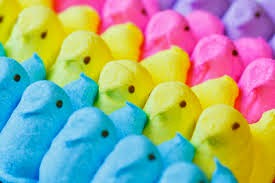
Easter will be here soon and I see Peeps in the stores. Peeps are a marshmallow candy formed in the shape of chicks (baby chickens) and named after the high-pitched little sound that real chicks make. Covered in neon-bright colored sugar, they are a typical Easter treat, popular in the U.S. and Canada.
Peeps are an example of kitsch: art, objects, or design considered to be in poor taste because of excessive garishness or sentimentality, but sometimes appreciated in an ironic way.
A funny fact about Peeps is that many people prefer them stale (hard and no longer fresh). Fresh marshmallows / fresh Peeps are soft. A couple of my friends make it a practice to break open the plastic packaging, allowing the air in, and they won’t eat their Peeps until they become hard and chewy.
Being a candy lover, I must admit that I won’t eat a Peep. I surprise myself but I can’t do it. I think it’s the colored sugar or the intensity of the marshmallow and sugar combination but I never eat them. My preferences aren’t a factor because an average of 5.5 million Peeps are made every day - quite a demand! Would you eat a Peep?
American Kitsch: Conversation Hearts
Tuesday, February 10, 2015
I WILL, REAL LOVE, ALL MINE, KISS ME
True love endures, and so does the lovable American sweet we call conversation hearts. This flirty, heart-shaped candy only makes an appearance once each year for Valentine's Day, full of hope and stamped with cute expressions of love.
Officially known as Sweethearts, about 8 million of these kitschy pastel hearts are sold each year and I love them. Besides their lasting popularity (Sweethearts were first created in 1866) they have a nostalgic simplicity which makes them so appealing . . . and slightly kitschy. Kitsch is defined as art, objects, or design considered to be in bad taste because of excessive garishness or sentimentality, but it's appreciated in an ironic way.
With Valentine's Day just around the corner, it's the perfect opportunity to express your true feelings with a sweet conversation. DEAR, BE MINE, IT'S LOVE
American kitsch: ugly Christmas sweaters
Thursday, December 11, 2014
Believe it or not, if you do an internet search with the key words “ugly Christmas sweater” you will find pages and pages of results, and you may wonder why so many people want an ugly Christmas sweater. Ironic as it is, this tacky item of clothing is a necessity for many holiday occasions and it’s an example of kitsch.
Kitsch is defined as art, objects, or design considered to be in bad taste because of excessive garishness or sentimentality, but sometimes appreciated in an ironic way. Ugly Christams sweaters possess all of those qualities.
There are ugly Christmas sweater contests, ugly Christmas sweater parties, ugly Christmas sweater theme days at work, and ugly sweater runs. December 12 is officially National Ugly Christmas Sweater Day!
In the past, this type of sweater was probably a nostalgic item or a funny gift you received and saved to wear once each year. Designed to be as unattractive as possible and often considered hideous, these awful sweaters have slowly changed from a fashion “don’t” to an ironically cool and trendy holiday necessity.
What is undeniable, the overly-festive, obnoxious Christmas sweater creates laughter and humor while it brings out memories of home and childhood.
The uglier, the better.
American kitsch: drive-in restaurants
Monday, July 21, 2014
There is a drive-in restaurant near my home called The Kiltie. It operates only during the summer season and is a rare type of restaurant in the USA, mainly because it’s nostalgic, perhaps even a dinosaur (something that is outdated or has become obsolete because of failure to adapt to changing circumstances).
At a drive-in restaurant, customers park their vehicles and are served by carhops (waitresses or waiters) who walk out to the cars to take food orders (some carhops do this on roller skates). The food is brought out on aluminum trays and clipped onto car windows. Drive-in menus normally consist of burgers, fries, sodas, and ice cream, and diners remain parked while they eat.
Don’t be mistaken to think that a drive-in restaurant is a drive-through restaurant. A drive-through restaurant doesn’t encourage diners to linger in their cars to eat and they aren’t old or nostalgic in any way. They operate to keep cars moving from the ordering window to the pay and pick-up window, where customers drive away and take their food with them.
Drive-ins are much more fun. The Kiltie, for example, was built by a Scottish businessman in the late 1940s and it hasn’t changed very much over the years. The carhops still wear plaid skirts (a kilt is a Scottish skirt), the menu is the same, and the ambience takes you back to the 1950s and 60s when drive-ins were at their height of popularity. That was a time when more people owned cars and gasoline prices were low so people were encouraged to drive and enjoy the roads.
If you visit the USA, I encourage you to find a drive-in restaurant to truly enjoy a nostalgic American experience.
American kitsch: marshmallows
Monday, February 3, 2014
All of our snow this winter reminds me of the popular Christmas song, “Marshmallow World”, that delights in snow and wintertime. Marshmallows, a sugary, spongy confection, are a kitchy food and pure fun. Kitsch is defined as art, objects, or design considered to be in bad taste because of excessive garishness or sentimentality, but sometimes appreciated in an ironic way.
Marshmallows alone have a pleasing consistency and are fantastic if you have a sweet tooth. They're great plain from the bag, dropped in hot chocolate, covered with chocolate, or roasted on a stick. When marshmallows are an ingredient in a recipe, desserts acquire a kitschy (and amazing) quality. Think s’mores, Rice Crispies Treats, and Peeps.
Food artisans are looking at the marshmallow in a different way, trying to give it a little class. They’ve taken the soft, fuffy, gooey, irresistable treat and created flavors like cinnamon, espresso, chocolate-rosemary, mango, and other dizzying combinations. New businesses dedicated to the marshmallow have also sprung up lately; Mia Mallows and Plush Puffs are some clever, cute examples.
I prefer the clear plastic bag of plain marshmallows for .99 cents sold at my grocery store. I know it’s not very elegent, but neither is anything kitsch.
American Kitsch: Conversation Hearts
Monday, February 4, 2013
I WILL, REAL LOVE, ALL MINE, KISS ME
True love endures, and so does the lovable American sweet we call conversation hearts. This flirty, heart-shaped candy only makes an appearance once each year for Valentine's Day, full of hope and stamped with cute expressions of love.
Officially known as Sweethearts, about 8 million of these kitschy pastel hearts are sold each year and I love them. Besides their lasting popularity (Sweethearts were first created in 1866) they have a nostalgic simplicity which makes them so appealing . . . and slightly kitschy. Kitsch is defined as art, objects, or design considered to be in bad taste because of excessive garishness or sentimentality, but it's appreciated in an ironic way.
With Valentine's Day just around the corner, it's the perfect opportunity to express your true feelings with a sweet conversation. DEAR, BE MINE, IT'S LOVE
Kitsch: Lava Lamp
Tuesday, August 14, 2012
It’s not too late to purchase a lava lamp. Invented in England in 1963, this instantly recognizable home accessory is probably the greatest and most captivating example of kitschy objects. Kitsch is defined as art, objects, or design considered to be in bad taste because of excessive garishness or sentimentality, but sometimes appreciated in an ironic way.
What is that stuff moving around in a lava lamp? According to the Oxford dictionary, it contains a viscous (thick) liquid in which a brightly colored waxy substance is suspended, rising and falling in irregular and constantly changing shapes. But I’d rather look at one than read about it.
This moving light provided hours of entertainment when it was popularized in the psychedelic sixties. Actually, the word psychedelic associates perfectly with a lava lamp because it visually relates to something with a dense, vivid color or a swirling abstract pattern, like a psychedelic t-shirt.
American Kitsch: Elvis Impersonators
Wednesday, February 22, 2012
In the world of American kitsch, Elvis is king. You can be serenaded by him in a restaurant or he can sell you something in a shop (that happened to me here in Milwaukee). He can even officiate at your wedding because there is an Elvis wedding chapel in Las Vegas where you can choose from several packages, including the Hound Dog special or the Pink Caddy (Cadillac) Wedding Package. That’s super-kitsch!
Elvis conventions, singing contests, look-alike contests, and tribute concerts are the norm, as is fat Elvis, black Elvis, or child Elvis. In fact, Elvis entertainers make up a unique branch of the entertainment industry and they attract large numbers of fans. Actually, this isn’t even particular to the United States because there are Elvis tribute artists all over the world: Italian Elvis, Greek Elvis, Japanese Elvis, and so on. Have you ever had an encounter with an Elvis impersonator in your country?
*photo courtesy of Mark WaiteAmerican Kitsch: Neon Boneyard in Las Vegas
Friday, June 24, 2011
Kitsch is defined as art, objects, or design considered to be in bad taste because of excessive garishness or sentimentality, but sometimes appreciated in an ironic way. I love the nostalgia and humor of American kitsch and here is a kitschy place I've always wanted to visit: Las Vegas' Neon Boneyard.
One of the things that makes Las Vegas so spectacular are the glowing lighted signs that illuminate the town. They're huge, sparkling, and a singularly unique Las Vegas art form. As Las Vegas modernizes, the vintage electric signs that represent motels, local businesses, and famous casino resorts from throughout Las Vegas are collected and saved in a sort of outdoor museum called the Neon Boneyard.
For years this museum has been accumulating the old signs and marquees that used to light up Las Vegas, with some dating back to the early 1930’s, and the reason it’s called the Neon Boneyard is because it's considered a cemetery for old, unwanted signs; in reality, it’s a museum that offers a fascinating, colorful glimpse into the history of early Las Vegas with its collection of larger-than-life, kitschy memorabilia. Though not a glamourous place (the signs are not lit anymore), this vast and amazing collection of huge signage offers a view into the legendary past of Las Vegas and its most memorable art form.
American Kitsch: Cookie Jars
Monday, February 21, 2011
Most Americans like eating cookes so it’s common for kitchens to have a cookie jar, a special container used for storing cookies. I have one, but my cookie jar is always empty because I eat cookies a lot.
Most cookie jars are made of ceramic (clay) material, which makes them easy to shape into animals and characters, and collecting the unusual or rare jars is a hobby for some people who like their humorous, charming, kitschy styles.
American Kitsch: Pink Flamingos
Sunday, October 24, 2010
Imagine an exotic pink flamingo - made of plastic - proudly adorning your garden or lawn.
The plastic pink flamingo is considered bad taste by many people and admired by others as retro cool. As a symbol of American kitsch, it has remained inexplicably popular for 53 years. The original flashy flamingo was sculpted in 1957 and 30 million have been sold since then.
Pink flamingos have a special place in the history of my old school, the University of Wisconsin-Madison. In 1979, as students walked the campus on their first day of classes, they were greeted by an unbelievable sight: 1,008 pink flamingos covering Bascom Hill (see photo). The idea was devised by two students and is remembered as a wildly popular and legendary prank (joke).
If you have any examples of kitsch in your country, please let me know!
American Kitsch--Wigwam Motel on Route 66
Tuesday, September 21, 2010
Kitsch is defined as art, objects, or design considered to be in bad taste because of excessive garishness or sentimentality, but sometimes appreciated in an ironic way. I love the nostalgia and humor of American kitsch and will occasionally share amusing examples of it in this blog.
On Route 66, one of the oldest and most famous highways in America, there is a motel that is classically American kitsch called The Wigwam Motel in Holbrook, Arizona. It receives a lot of attention not only because of its location on Route 66 but also because it is near several Native American Indian reservations: Navajo, Hopi, and the White Mountain Apache. It was built in the 1930’s, is officially listed in the National Register of Historic places, and is still open today. I would love to stay there.


