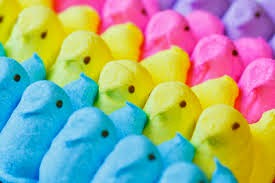
American kitsch: Peeps

Monday, March 23, 2015


Easter will be here soon and I see Peeps in the stores. Peeps are a marshmallow candy formed in the shape of chicks (baby chickens) and named after the high-pitched little sound that real chicks make. Covered in neon-bright colored sugar, they are a typical Easter treat, popular in the U.S. and Canada.


Peeps are an example of kitsch: art, objects, or design considered to be in poor taste because of excessive garishness or sentimentality, but sometimes appreciated in an ironic way.

A funny fact about Peeps is that many people prefer them stale (hard and no longer fresh). Fresh marshmallows / fresh Peeps are soft. A couple of my friends make it a practice to break open the plastic packaging, allowing the air in, and they won’t eat their Peeps until they become hard and chewy.

Being a candy lover, I must admit that I won’t eat a Peep. I surprise myself but I can’t do it. I think it’s the colored sugar or the intensity of the marshmallow and sugar combination but I never eat them. My preferences aren’t a factor because an average of 5.5 million Peeps are made every day - quite a demand! Would you eat a Peep?

March 17 is St. Patrick's Day

Sunday, March 15, 2015


In honor of Saint Patrick’s Day, which is March 17, and also to tribute my sweet Irish friend Pat, who passed away recently, I present some Irish good wishes to you!


May good luck be your friend
In whatever you do
And may trouble be always
A stranger to you.
------------------------------

Like the warmth of the sun
And the light of the day,
May the luck of the Irish
shine bright on your way.


Happy Saint Patrick’s Day!


Make up your mind = decide

Wednesday, March 4, 2015

Should I have the chicken or the salmon? Should I buy the sunglasses or the leather jacket? Should I accept the offer?

"Decide" is a useful verb to express choice. The idiom to make up my mind also means to decide “There are so many choices in this menu. It’s going to take a while to make up my mind/decide.” You can finish this sentence with either the idiom or the verb “decide.”

There are two ways to decide somthing / make up your mind about something:

1) To decide what to choose: Alessandra can't make up her mind / decide whether to accept the position in London or NYC.

2) To become very certain that you want to do something: At a very early age Sally “made up her mind / decided” to become a ballerina.

With so many choices in life, it’s difficult for me to make up my mind sometimes.

Emotional roller coaster

Wednesday, February 25, 2015


A roller coaster is a thrill ride that features extreme heights and sharp curves. If you think the only place you can encounter a roller coaster is at an amusement park, I have a different kind that we all experience in our lives: the emotional roller coaster.

An emotional roller coaster (also called a roller coaster or a roller coaster ride) is an English idiom used to describe an experience that involves many emotional highs and lows, or really good times alternating with really difficult times. The expression’s origin refers to the fact that a roller coaster ride has many steep climbs and falls, and riding one at high speed is both exciting and terrifying. It perfectly illustrates many of life’s experiences such as travel, getting married, having a baby, or changing jobs.

A situation or experience that alternates between making you feel excited, exhilarated, or happy and making you feel sad, disappointed, or desperate is an emotional roller coaster. What in your life has been an emotional roller coaster?

EAT and related vocabulary

Wednesday, February 18, 2015


To eat is a verb. We eat when we’re hungry and sometimes when we're not (out of boredom, for example). Sometimes we love our meal and sometimes we don’t have an appetite. Look at the following eating styles and note the differences:

nibble ---> eat ---> munch ---> gnaw ---> devour

These are not synonyms. Each word has a specific, different meaning related to the word "eat", ranging from weaker (on the left) to stronger, higher levels of intensity (on the right).

nibble: take small bites
eat: to consume food
munch: to eat continuously while chewing noisily
gnaw: to bite or nibble something persistently
devour: to eat hungrily or quickly


To add informality to your English conversations, try familiarizing yourself with these related idioms:

pick at: eat food in small amounts or without much of an appetite
wolf down: devour food greedily
inhale: eat food rapidly or greedily


Do you understand the words?

1. A sick person might "pick at" their food. YES NO
2. To "eat" involves chewing and swallowing food. YES NO
3. Good snacks to "munch" are potato chips or popcorn. YES NO
4. A hungry teenager can easily "inhale" a pizza. YES NO
5. A mouse might "nibble" on some cheese. YES NO
6. A person with a small appetite usually "devours" a meal. YES NO
7. A person with a large appetite can "wolf down" a meal. YES NO
8. A nervous person might "gnaw" on their fingernails. YES NO

_______________________________________________________________
1. yes, 2. yes, 3. yes, 4. yes, 5. yes, 6. no, 7. yes, 8. yes

_______________________________________________________________

Can you remember the words? (Use correct verb forms)

1. Silvia loves to m _ _ _ _ on popcorn at the cinema.
2. Rebecca gets a stomach ache whenever she e_ _ _ too much candy.
3. Paolo can i _ _ _ _ _ a hamburger in two bites.
4. Andrea never eats his vegetables. He just p _ _ _ _ a_ his plate.
5. My brother will w _ _ _ d _ _ _ his dinner after football practice.
6. The homeless man always d _ _ _ _ _ _ his free meal.
7. My pet rabbit likes to n _ _ _ _ _ on carrots.
8. Jerry’s dog was happily g_ _ _ _ _ _ on a bone in the kitchen.

_______________________________________________________________

1. munch, 2. eats, 3. inhale, 4. picks at, 5. wolf down, 6. devours, 7. nibble, 8. gnawing

_______________________________________________________________

American Kitsch: Conversation Hearts

Tuesday, February 10, 2015


I WILL, REAL LOVE, ALL MINE, KISS ME

True love endures, and so does the lovable American sweet we call conversation hearts. This flirty, heart-shaped candy only makes an appearance once each year for Valentine's Day, full of hope and stamped with cute expressions of love.

Officially known as Sweethearts, about 8 million of these kitschy pastel hearts are sold each year and I love them. Besides their lasting popularity (Sweethearts were first created in 1866) they have a nostalgic simplicity which makes them so appealing . . . and slightly kitschy. Kitsch is defined as art, objects, or design considered to be in bad taste because of excessive garishness or sentimentality, but it's appreciated in an ironic way.

With Valentine's Day just around the corner, it's the perfect opportunity to express your true feelings with a sweet conversation. DEAR, BE MINE, IT'S LOVE

Bacon mania

Friday, January 30, 2015


People are attentive to their diets more than ever these days, trying to eat in healthier or more thoughtful ways and making food choices that reflect nutritious, personal, or religious beliefs. Here in the USA there is one puzzling exception that has a strong presence in the American food scene and it’s called bacon mania.

Mania means to have an excessive enthusiasm or desire for something, and the use of this tasty pork product in an increasing variety of recipess correlates with its growing demand. The more creative you can be with bacon, the more people like it, and food producers have become quite imaginative! There’s bacon gum, bacon-wrapped hot dogs, bacon chocolate bars, bacon cupcakes, and bacon ice cream.

If you’d rather look at bacon instead of eating it, consider a bacon watch for yourself,
bacon air freshener, a bacon wallet , or clean your teeth with some bacon toothpaste.

I personally haven’t fallen for (I’m not captivated by) the current bacon mania trend but I think I’d like to try bacon ice cream.